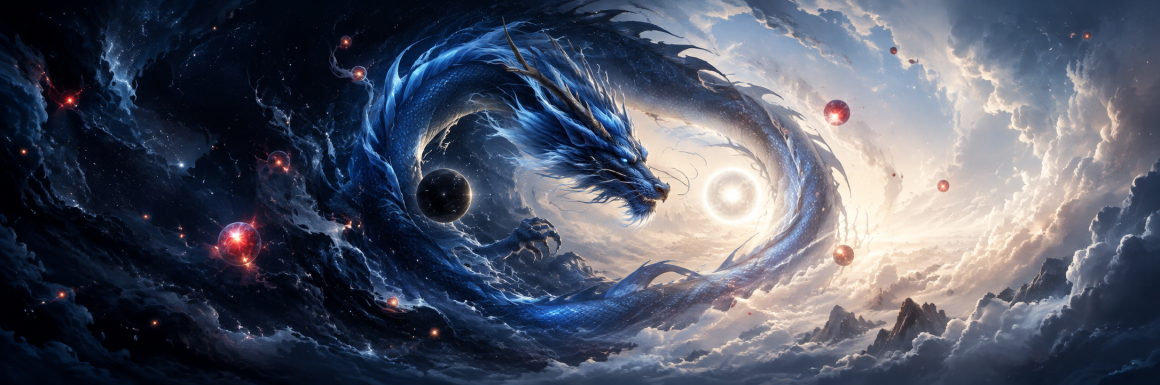
Theory of the Existence of Oblivion
I. Fundamental Postulate
The Theory of the Existence of Oblivion holds that created reality cannot be adequately understood as a simple struggle between light and darkness, good and evil, virtue and sin. These categories represent human approximations to a much broader metaphysical structure.
Oblivion is the name given to the theological-philosophical principle according to which all created reality exists within a spectrum of possibilities known, permitted, and ultimately governed by God, while created beings can perceive only fragments of that spectrum.
Therefore:
Oblivion exists because there is an inevitable distance between the totality of divine reality and the fraction of it that a created consciousness can understand.
It is not necessarily a place, an entity, or a force independent from God. Oblivion is, above all, an ontological condition of created knowledge and existence.
II. The Axiom of Divine Totality
The theory begins with one principle:
If God is absolute, omniscient, and Creator, then no dimension of reality can truly exist outside His knowledge or power.
This implies that God does not perceive only what human beings call light, goodness, order, or virtue.
God simultaneously perceives:
- what has occurred;
- what is possible;
- what will never occur;
- light;
- darkness;
- order;
- chaos;
- the consequences of every decision;
- the moral possibilities of every creature;
- what a creature understands;
- and what remains incomprehensible to it.
Human vision observes points.
Divine vision contemplates the entire spectrum.
From this difference arises the first necessary condition for Oblivion.
III. The Problem of Limited Perception
Human beings interpret reality through oppositions:
light / darkness
good / evil
virtue / sin
salvation / damnation
order / chaos
Yet these oppositions may function as necessary cognitive tools without necessarily representing the complete metaphysical nature of what they describe.
A person who sees only a small section of a circle may believe that they are looking at a straight line.
Likewise, human beings may interpret certain elements of reality as absolute contradictions because they lack the perspective necessary to understand their place within a greater whole.
Therefore, Oblivion proposes:
Apparent contradiction may be the consequence of incomplete perspective.
This does not mean that good and evil are equivalent, nor that every action is morally acceptable.
It means that the ultimate explanation for their existence may exceed the human capacity to understand it.
IV. The Principle of the Divine Spectrum
Imagine reality as a spectrum.
Human beings can perceive only certain wavelengths.
God, by contrast, perceives the whole.
The metaphor of light is useful.
The human eye recognizes only a small portion of the electromagnetic spectrum. The fact that a form of radiation is invisible to us does not mean that it does not exist.
Oblivion extends this principle into the metaphysical realm:
Human inability to understand a dimension of reality does not constitute evidence that such a dimension is meaningless or nonexistent.
Moral reality may possess a similar complexity.
Humanity distinguishes certain expressions as virtues and others as sins because operational categories are necessary for life.
But God would know not only the action itself, but also:
- intention;
- available knowledge;
- ignorance;
- trauma;
- actual freedom;
- external pressure;
- context;
- consequences;
- alternative possibilities;
- repentance;
- later transformation;
- impact on other people.
Therefore, no human action exists metaphysically in isolation.
V. Light and Darkness
Within Oblivion, darkness should not automatically be identified with evil.
Darkness may be understood as absence of understanding, concealment, limitation, potentiality, or a dimension that has not yet been revealed.
For example, night is not morally evil.
Silence is not evil.
Biological death is not, in itself, a moral act.
Neither is sadness.
For this reason, two concepts can be distinguished:
Created Darkness
This is the darkness that forms part of the structure of existence.
It may include:
- mystery;
- rest;
- mourning;
- protective fear;
- pain that warns;
- destruction necessary for renewal;
- limits;
- justice;
- consequences;
- uncertainty.
It does not necessarily stand in opposition to God.
Corruptive Darkness
This is darkness in which conscious will seeks to unjustly destroy, dominate, degrade, or deny the dignity of other creatures.
This darkness acquires a moral dimension.
The distinction between these two forms is one of the central ideas of Oblivion.
VI. Virtues and Blessings
Traditional theology recognizes virtues symbolically associated with light.
Oblivion introduces a second category: Blessings.
A Blessing is a moral expression arising from something that may culturally appear dark, yet may fulfill a just purpose when directed toward a legitimate end.
For example:
Virtue: forgiveness.
Blessing: justice against the aggressor.
Forgiveness prevents hatred from ruling the individual.
Justice prevents the aggressor from remaining without limits or consequences.
Both may coexist.
Another example:
Virtue: mercy.
Blessing: protective severity.
A society incapable of mercy becomes cruel.
A society incapable of imposing limits may also permit cruelty.
Moral perfection would therefore not necessarily be found at one extreme, but in the ability to use each dimension correctly.
VII. The Principle of Integration
From this emerges one of the central principles of Oblivion:
Spiritual maturity does not consist only in rejecting one’s own darkness, but in recognizing it, understanding it, limiting it, and integrating it under a higher moral orientation.
A person incapable of anger might also be incapable of defending an innocent person.
A person ruled by anger may become an aggressor.
Therefore:
uncontrolled anger → destruction
but:
understood anger + reason + justice → protection
The same may apply to other emotions traditionally associated with darker dimensions of human experience.
The fundamental problem does not always lie in the existence of a capacity.
It may instead lie in what governs that capacity and toward what purpose it is directed.
VIII. Oblivion as a Boundary
Oblivion can therefore be conceptualized as a boundary.
On one side lies:
what the creature understands.
On the other:
what exists within divine reality but remains incomprehensible to the creature.
The boundary moves.
Every scientific discovery, philosophical reflection, and spiritual deepening partially shifts it.
But it never disappears completely.
A finite creature cannot acquire an absolutely infinite perspective without ceasing to be finite.
Therefore:
As long as a difference exists between God and the creature, Oblivion exists.
IX. The Theorem of Oblivion
The theory may be expressed formally.
Let:
D = the totality of divine knowledge.
H = the set of everything a human mind can understand.
If God possesses absolute knowledge:
H ⊂ D
Then there necessarily exists a set:
O = D − H
where O represents that which belongs to reality as known by God but remains outside human understanding.
That set is called:
Oblivion
Therefore:
If D > H, then O ≠ ∅.
In words:
If divine knowledge exceeds human knowledge, then there necessarily exists a dimension of reality that remains incomprehensible to human beings. That dimension is Oblivion.
X. Oblivion and Free Will
The existence of Oblivion also allows for a particular interpretation of free will.
A creature makes decisions using incomplete information.
God would know every possibility resulting from each choice.
This creates an important distinction between:
knowing a decision
and
causing a decision.
The fact that God knows a choice in advance does not necessarily imply that He forces the creature to make it.
From the human perspective, uncertainty exists.
From the divine perspective, complete knowledge may exist.
Oblivion is precisely the region separating these two perspectives.
XI. Oblivion and the Problem of Evil
One of the central questions of theology is:
If God is good and omnipotent, why does suffering exist?
Oblivion does not claim to fully solve this question.
Instead, it proposes something different:
the problem may be partially insoluble from a human perspective because we are attempting to judge a totality while observing only a fragment of it.
This does not mean:
“Every form of suffering happens for a reason that we understand.”
Oblivion argues almost the opposite:
An ultimate reason may exist while remaining inaccessible to us.
It also recognizes that certain forms of suffering are direct consequences of human decisions, unjust structures, natural accidents, or the limitations inherent in material existence.
Therefore, mystery must never become an excuse for tolerating preventable suffering.
XII. Oblivion and Salvation
Within this theory, salvation should not be understood merely as a moral score based on adding good and bad actions.
Perfect judgment would require complete knowledge of a person.
This would include:
what they did
why they did it
what they understood
what they were truly capable of doing
what opportunities they had
what harm they caused
what repair they sought
what they ultimately became.
A human mind can rarely possess all this information.
An omniscient mind, by definition, could.
Therefore:
Human judgment observes actions; divine judgment may observe entire trajectories of existence.
XIII. Angels, Demons, and Human Beings
Oblivion also allows a metaphysical distinction between three symbolic forms of existence.
Angels
They would represent creatures highly aligned with specific principles of divine order.
Demons
They would represent creatures whose will has become oriented toward radical opposition to divine order.
Humans
Human beings occupy an intermediate and dynamic condition.
A human can:
love and hate,
create and destroy,
forgive and seek vengeance,
sacrifice and act selfishly,
fall and transform.
Their defining characteristic would therefore be moral plasticity.
Thus, within Oblivion, humanity occupies a unique position:
It represents neither the perfection of light nor absolute fixation in darkness, but the continuous possibility of movement across the moral spectrum.
XIV. The Paradox of Oblivion
A final paradox emerges.
To completely understand Oblivion, one would have to know that which, by definition, lies beyond one’s understanding.
Therefore:
When Oblivion is completely understood, it ceases to be Oblivion.
Knowledge moves its boundary.
But immediately, a new boundary appears.
Thus:
knowledge → reveals ignorance → generates new knowledge → reveals even greater ignorance.
Oblivion never disappears.
It only retreats.
XV. The Supreme Principle of Oblivion
The entire theory can be condensed into a single proposition:
Reality is greater than the perception any creature possesses of it.
And if God represents totality:
Everything that human beings know belongs to divine reality, but divine reality is not limited to what human beings are capable of knowing.
Oblivion is the name given to that difference.
It is not merely darkness.
It is not evil.
It is not the absence of God.
It is the horizon between finite understanding and infinite totality.
XVI. Final Conceptual Formula
The structure of Oblivion may be summarized as:
GOD
↓
Totality of what is possible and what exists
↓
Creation
↓
Light ↔ Darkness
↓
Virtues ↔ Blessings
↓
Consciousness ↔ Unconsciousness
↓
Order ↔ Chaos
↓
Knowledge ↔ Mystery
↓
Humanity
↓
Partial interpretation of reality
↓
OBLIVION
The boundary between what a creature is capable of understanding and what only an absolute perspective could perceive in its entirety.
Conclusion
The Theory of the Existence of Oblivion argues that Oblivion does not need to exist as an independent physical realm in order to be real.
Its existence follows logically from the difference between a limited consciousness and a potentially unlimited reality.
If God knows everything and human beings do not know everything, then there necessarily exists an epistemological region between those two states.
That region contains mystery, unknown possibilities, hidden dimensions of morality, the ultimate reasons behind creation, and every aspect of existence that a creature is not yet capable of understanding.
Oblivion can therefore ultimately be defined as:
The metaphysical space of mystery: the distance between reality as it exists in its totality and reality as a creature is capable of understanding it.
 Furry-Spice