
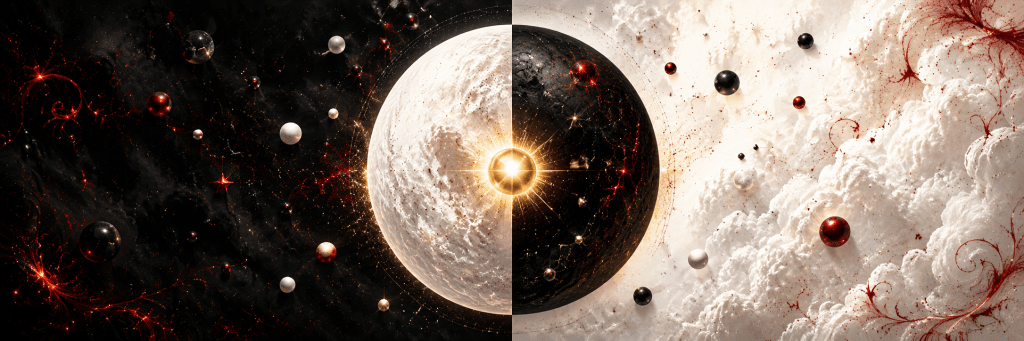
Understanding the Theory of Oblivion
What If Reality Is Larger Than We Can Understand?
Human beings naturally divide the world into categories.
Good or evil.
Light or darkness.
Order or chaos.
Right or wrong.
These distinctions are necessary for everyday life, but Oblivion begins with a question:
What if reality itself is more complicated than the categories our minds use to understand it?
The Theory of Oblivion proposes that a finite mind cannot possess an infinite perspective.
If God possesses complete knowledge while humanity possesses incomplete knowledge, then something must exist between those two perspectives.
That unknown territory is called Oblivion.
Light and Darkness Are Not Always Good and Evil
One of Oblivion’s central distinctions is between darkness and evil.
Night is dark but not evil.
Grief is painful but may deepen empathy.
Fear may become destructive, but it can also protect us from danger.
Anger can harm others, yet anger at injustice can motivate someone to protect the vulnerable.
Oblivion therefore asks us to examine not only what we feel, but what we do with what we feel.
Virtues and Blessings
Virtues represent constructive qualities such as compassion, patience, humility, courage, and forgiveness.
Oblivion introduces Blessings as constructive transformations of qualities associated with darker experiences.
For example:
anger + self-control + justice = protection
Instead of denying difficult emotions, Oblivion encourages understanding and ethical integration.
The Central Idea
The theory can ultimately be summarized in one sentence:
Reality is greater than the perception any creature possesses of it.
Oblivion is therefore an invitation to combine conviction with humility—to search for truth while remembering that human understanding is always incomplete.
4. LEARN — 7 EDUCATIONAL CAPSULES
Capsule 1 — Why Is It Called Oblivion?
Approx. 100 words
The word Oblivion normally suggests something forgotten or hidden.
Within this philosophy, however, it represents something slightly different: what exists beyond the current limits of understanding.
Imagine standing at the edge of an enormous forest. You can see the first trees, but you cannot see everything hidden beyond them.
Your inability to see the entire forest does not mean the rest of it does not exist.
Oblivion applies the same principle to reality.
Human beings perceive fragments.
An omniscient God, by definition, would perceive the whole.
The space between those perspectives is what the theory calls Oblivion.
Capsule 2 — The Divine Spectrum
Approx. 120 words
Human eyes perceive only a small portion of the electromagnetic spectrum.
Infrared and ultraviolet radiation can exist even though our eyes cannot directly see them.
The Divine Spectrum uses this scientific reality as a metaphor.
Human consciousness may also perceive only a limited portion of existence.
We understand events according to our experiences, emotions, culture, knowledge, and personal history.
A divine perspective would theoretically include every cause, consequence, intention, possibility, and future outcome simultaneously.
The lesson is not that human reasoning is useless.
Quite the opposite.
Oblivion encourages us to learn as much as possible while remaining aware that our perspective is never identical to reality itself.
Capsule 3 — Is Darkness Evil?
Approx. 100 words
Not necessarily.
Oblivion distinguishes darkness from evil.
Darkness may represent mystery, uncertainty, pain, silence, endings, fear, grief, or things that remain unknown.
Many of these experiences are difficult, but difficulty alone does not make them evil.
The philosophy therefore separates Created Darkness from Corruptive Darkness.
Created Darkness belongs to the structure of existence.
Corruptive Darkness emerges when conscious beings intentionally use their freedom to unjustly harm, dominate, or degrade others.
The distinction helps Oblivion avoid a simplistic equation:
dark = evil
and instead asks:
What purpose does it serve?
Capsule 4 — What Are Blessings?
Approx. 130 words
A Blessing is one of the distinctive concepts of Oblivion.
Virtues describe traditionally positive moral qualities.
Blessings describe constructive expressions arising from emotions or characteristics that often appear darker.
Consider anger.
Uncontrolled anger may become violence.
But anger at injustice can motivate a person to protect someone being harmed.
The emotion itself has not disappeared.
It has been integrated and directed toward an ethical purpose.
The same principle can apply to fear, severity, ambition, grief, or competitiveness.
Oblivion therefore does not teach that every impulse should be followed.
It teaches almost the opposite:
powerful impulses must be understood, controlled, and directed responsibly.
A Blessing is darkness placed under the guidance of ethical purpose.
Capsule 5 — The Oblivion Boundary
Approx. 100 words
Imagine drawing a circle containing everything humanity currently understands.
Outside that circle lies everything we have not yet discovered.
When humans discover something new, the circle becomes larger.
But something interesting happens:
its boundary also grows.
More knowledge often produces more questions.
Oblivion calls this changing frontier the Oblivion Boundary.
Science can move it.
Philosophy can move it.
Experience can move it.
Spiritual reflection can move it.
But if reality is greater than any individual mind, the boundary never completely disappears.
Knowledge therefore becomes both an achievement and a reminder of humility.
Capsule 6 — Oblivion and Free Will
Approx. 120 words
Can God know what someone will choose without causing that choice?
Oblivion distinguishes two concepts:
knowledge and causation.
Imagine watching a recorded football match whose result you already know.
Your knowledge of the final score does not cause the players to make their decisions.
The theological problem is far more complicated, but the analogy illustrates the distinction.
Within Oblivion, human beings experience decisions from a limited perspective.
We face uncertainty and choose among possibilities.
An omniscient perspective could theoretically know those choices without necessarily removing their voluntary nature.
The distance between these perspectives—human uncertainty and divine knowledge—is another expression of Oblivion.
Capsule 7 — The Oblivion Paradox
Approx. 100 words
There is a strange paradox at the center of Oblivion.
If something completely unknown becomes understood, it no longer belongs to Oblivion.
Knowledge pushes the boundary backward.
But new knowledge usually reveals new questions.
Therefore:
knowledge reveals ignorance → ignorance motivates discovery → discovery reveals deeper unknowns.
Oblivion never completely disappears.
It retreats.
This is why intellectual humility is central to the philosophy.
The objective is not to stop searching because we cannot know everything.
The objective is to search precisely because there will always be more to understand.
 Furry-Spice